

Morning pain and stiffness
The first steps after sleep or sitting may be sore, then ease with movement. The response the next morning is also useful for judging whether the previous day’s load was tolerated.
Assessment and progressive calf loading for Achilles pain and stiffness during walking, running, jumping or sport.

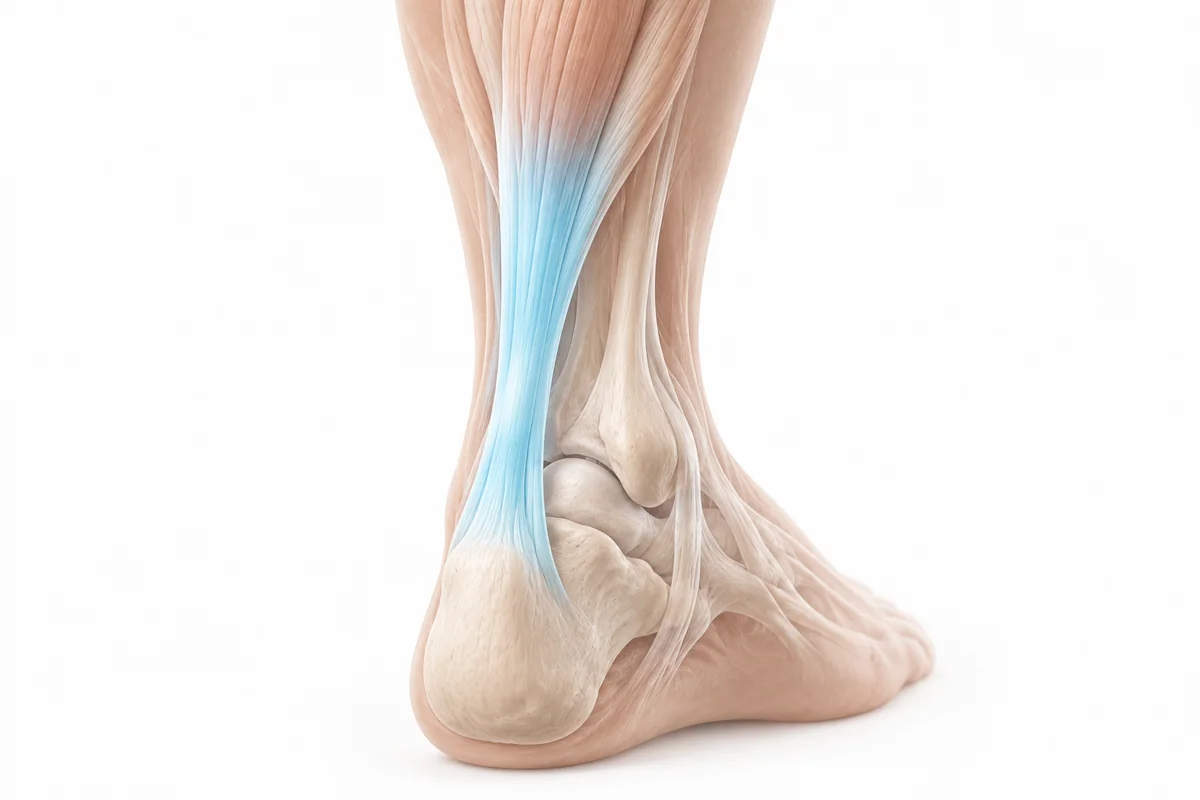
Drag to rotate through 360 degrees. With the model focused, use the arrow keys to rotate and Home to return to the overview. The highlighted area shows relevant anatomy, not a diagnosis or an individual scan.
The Achilles tendon transfers force from the calf to the heel during walking, running and jumping. Tendinopathy often develops when the tendon’s current capacity is exceeded by a change in running, speed work, hills, court sport or calf loading.
Midportion symptoms occur several centimetres above the heel. Insertional symptoms occur where the tendon meets the heel bone and can be more sensitive to compression in deep ankle bend. These presentations often need different exercise ranges.
The first steps after sleep or sitting may be sore, then ease with movement. The response the next morning is also useful for judging whether the previous day’s load was tolerated.
Pain may reduce during activity and return afterwards. Feeling better once warm does not necessarily mean the tendon is ready for unrestricted speed or volume.
Heel raises, running, jumping and uphill work commonly provoke symptoms because they require repeated force from the calf-Achilles unit.
These patterns help explain what to look out for. They do not confirm a diagnosis on their own.
Midportion pain sits above the heel; insertional pain is where the tendon joins the heel bone.
The tendon can feel stiff when first moving, then change as activity continues.
Running, hopping, jumping or calf raises may reproduce symptoms.
Strength or repeated calf-raise endurance may decline. A sudden snap with loss of push-off needs urgent assessment.
Assessment confirms whether the Achilles is the likely pain source, distinguishes midportion from insertional symptoms and identifies the loads the tendon currently tolerates.
The exact location, local thickening, tenderness and symptom response to compression help classify the presentation and rule out nearby heel conditions.
Double-leg and single-leg heel raises can assess pain, height, repetitions and control. Heavier strength or power testing may be appropriate later.
The progression from daily walking to hopping and running shows how the tendon responds to increasing force and rate of loading.
A sudden kick or snap sensation, rapid weakness and inability to push off requires prompt assessment for rupture. Tendinopathy and rupture are not managed the same way.
Progressive tendon loading is central to rehabilitation. The exercise type is selected by current irritability and the force, speed and volume required for the person’s goal.
Walking, running and calf work are adjusted using pain during activity and the response later that day and the following morning.
Heel raises can progress from both legs to one leg, then to heavier straight-knee and bent-knee loading. Insertional pain may initially require avoiding deep heel-drop positions.
Faster calf work, skipping, hopping and jumping prepare the tendon for storing and releasing energy once slower strength is tolerated.
Easy running, hills, faster pace, acceleration and repeated sport efforts are progressed separately so tendon response is clear.
Book when Achilles pain or morning stiffness persists, running volume is falling, or symptoms recur each time speed or hills increase. A sudden snap, major weakness or inability to push off needs urgent assessment for rupture.
Book online or call
08 6183 1790
Practical answers about symptoms, assessment and recovery.
It depends on the presentation. Deep dorsiflexion may aggravate insertional symptoms through compression. Assessment can determine whether mobility work is useful and which range is appropriate.
Some running can often continue if the tendon response remains acceptable. Distance, pace, hills and frequency may need separate adjustments while calf capacity is rebuilt.
Heel drops are one loading option, not a universal programme. Exercise range, resistance, speed and progression should match tendon location, irritability and the activity goal.
A sudden snap or kick sensation, immediate loss of push-off strength and difficulty with a calf raise are concerning. Seek urgent assessment rather than testing it repeatedly yourself.
Book online or call our Cottesloe team.
General educational information; your assessment determines the appropriate care. Supporting reference: AAOS Achilles tendon information.
3D bone and tissue source: BodyParts3D, © The Database Center for Life Science, CC BY-SA 2.1 Japan. Meshes cropped and simplified, with illustrative highlights and some simplified soft tissues. Supporting artwork is illustrative and does not represent a scan or confirm a diagnosis. Attribution and licence.