

A painful arc
Some people feel pain through part of the lifting range and less pain above or below it. This can support a rotator cuff related pattern but is not diagnostic by itself.
Assessment for shoulder pain during lifting and overhead activity, with treatment directed by the actual movement, strength and load findings.

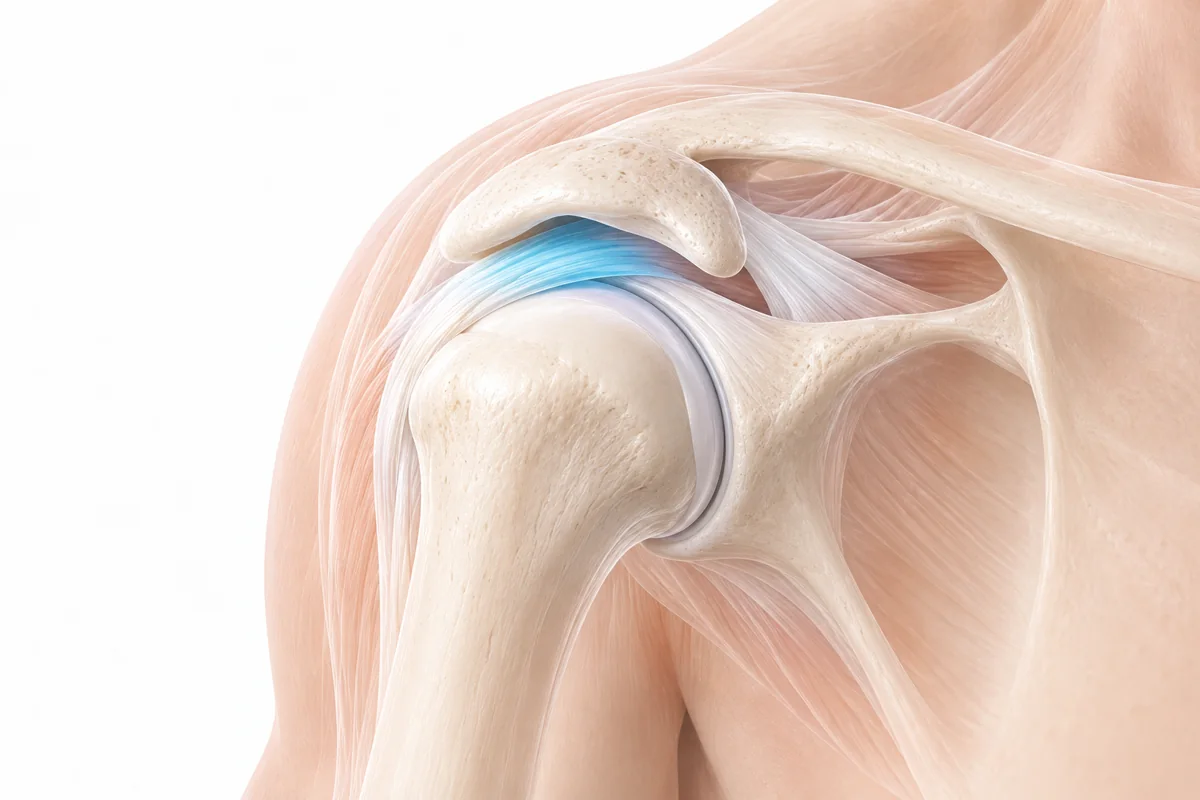
Drag to rotate through 360 degrees. With the model focused, use the arrow keys to rotate and Home to return to the overview. The highlighted area shows relevant anatomy, not a diagnosis or an individual scan.
Shoulder impingement is a familiar label for pain during arm elevation, reaching or overhead loading. Current clinical reasoning does not treat it as proof that one structure is simply being pinched by a fixed bone shape.
Symptoms may involve the rotator cuff, bursa and the wider shoulder system. Tendon capacity, recent load, movement options, sleep, work and sport can all influence the presentation, so treatment should be based on the person’s findings rather than the label alone.
Some people feel pain through part of the lifting range and less pain above or below it. This can support a rotator cuff related pattern but is not diagnostic by itself.
Symptoms may build with swimming, throwing, racquet sport, pressing, serving, painting or repeated reaching. The provoking volume and recovery between sessions are important.
The shoulder may tolerate an activity initially but become more painful later that day or overnight. This delayed response helps set the starting dose for rehabilitation.
These patterns help explain what to look out for. They do not confirm a diagnosis on their own.
A painful part of the lifting range is common, although it does not prove that a structure is being pinched.
Pressing, swimming, throwing or work above shoulder height can increase symptoms.
The shoulder may become uncomfortable at night or when compressed against a pillow.
Symptoms may follow an increase in overhead volume or intensity. Strength, recovery and task demands also matter.
Assessment looks beyond a single impingement test because several shoulder conditions can produce a similar pain response.
Active and passive elevation, rotation and reaching are compared for range, pain and control. The neck can also be screened when symptoms extend down the arm.
Rotator cuff and scapular muscle tests can show whether pain, force loss or endurance limits are present in the positions that matter.
Changing range, resistance, grip, shoulder-blade support or exercise angle may show how the painful task can be trained more tolerably.
Marked stiffness, instability, trauma, neurological symptoms or major weakness can point toward a different or additional shoulder problem and alter the plan.
The aim is not to avoid elevation forever. Rehabilitation creates a tolerable path back to reaching, lifting and overhead work while improving the capacities relevant to that task.
Training volume, exercise range, load or frequency can be changed temporarily. Keeping tolerable shoulder activity usually gives a clearer progression than repeated stop-start rest.
Isometric, isotonic and later faster or heavier exercises may be used depending on irritability and goals. Exercise should be adjusted by response, not chosen from a generic list.
Scapular muscle work may be useful when examination shows a relevant strength, endurance or movement deficit. It is one part of the shoulder system rather than a universal correction.
Later rehabilitation can include pressing, pulling, swimming, throwing, serving or repeated work overhead with planned increases in volume and intensity.
Book when overhead pain is limiting work, gym or sport, when symptoms regularly disturb sleep, or when reducing activity has not restored shoulder capacity. Sudden major weakness or loss of movement after trauma needs prompt assessment.
Book online or call
08 6183 1790
Practical answers about symptoms, assessment and recovery.
That explanation is often too simple. Overhead pain may involve rotator cuff or bursal tissues, but symptoms are also influenced by tissue capacity, recent load and shoulder function. Assessment should test these factors rather than assume one fixed cause.
A short-term reduction or change may help if the shoulder is highly irritable, but the long-term goal is usually to restore overhead tolerance. An assessment can set a suitable starting range and load.
Posture can change how a task feels, but there is no single correct posture that explains every case. Strength, load, movement options and the task itself are assessed together.
Book when pain persists, affects sleep or strength, or stops normal work, gym or sport. Seek prompt assessment after trauma if there is marked weakness or inability to raise the arm.
Book online or call our Cottesloe team.
General educational information; your assessment determines the appropriate care. Supporting reference: AAOS shoulder information.
3D bone and tissue source: BodyParts3D, © The Database Center for Life Science, CC BY-SA 2.1 Japan. Meshes cropped and simplified, with illustrative highlights and some simplified soft tissues. Supporting artwork is illustrative and does not represent a scan or confirm a diagnosis. Attribution and licence.