

Load-related pain
Symptoms usually increase with actions that load the involved tendon, such as running, jumping, gripping, lifting or lying on a compressed gluteal tendon.
Assessment and progressive loading for tendon pain that limits running, jumping, lifting or repeated sport and work tasks.

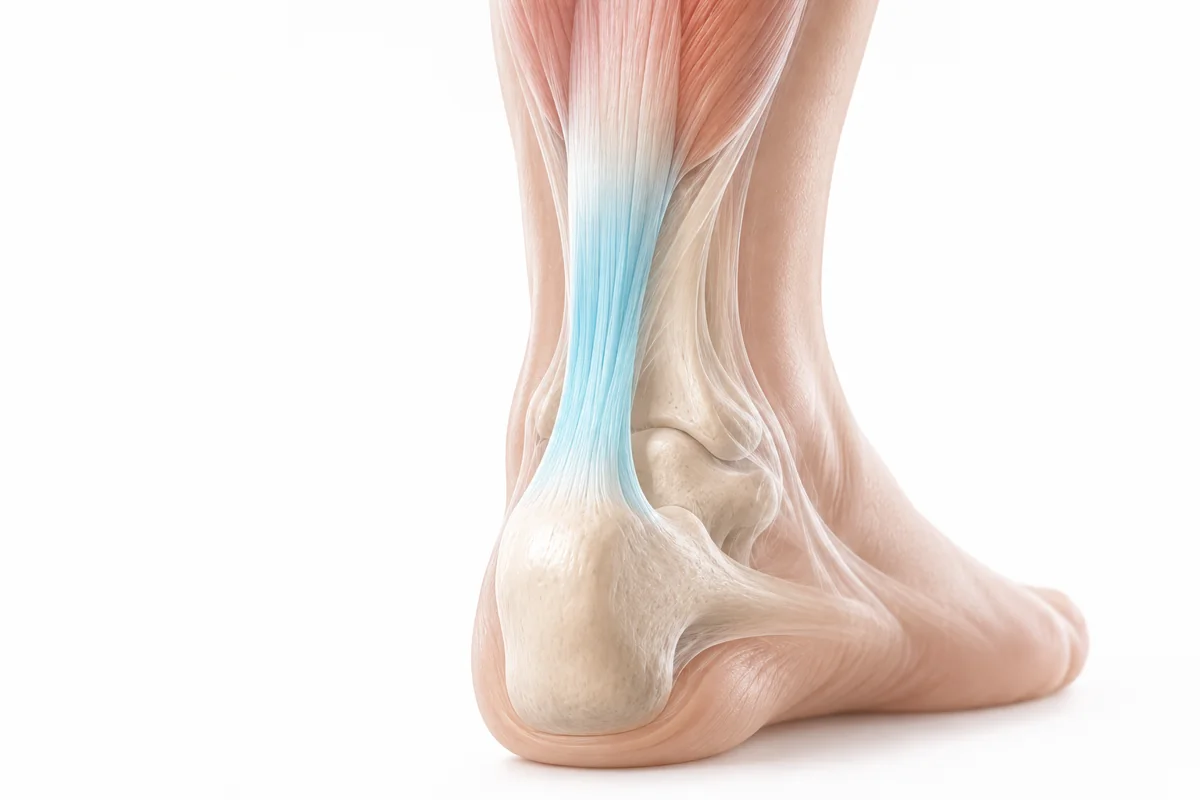
Drag to rotate through 360 degrees. With the model focused, use the arrow keys to rotate and Home to return to the overview. The highlighted area shows relevant anatomy, not a diagnosis or an individual scan.
Tendinopathy describes persistent pain and reduced function associated with a tendon. Common sites include the Achilles, patellar, gluteal, hamstring, rotator cuff and elbow tendons, but each is loaded differently and should not receive the same generic exercise sheet.
Symptoms often follow a mismatch between tendon capacity and a change in training, work or recovery. Scan changes can support diagnosis in selected cases, but tendon abnormalities can exist without pain and symptom severity does not always match imaging.
Symptoms usually increase with actions that load the involved tendon, such as running, jumping, gripping, lifting or lying on a compressed gluteal tendon.
Morning or start-up stiffness is common in some tendons. The response after activity and the next day helps judge whether the load was appropriate.
A tendon may warm up enough to complete activity while strength, power or repeat-effort capacity remains below the required level.
These patterns help explain what to look out for. They do not confirm a diagnosis on their own.
Symptoms often appear during the movement that loads the affected tendon, such as jumping, gripping or overhead work.
The area can feel stiff at the start of movement and change during a session.
You may tolerate less resistance, fewer repetitions or less sport than previously.
Training, work or recovery changes can outpace tendon capacity. Each tendon needs a location-specific assessment.
Assessment identifies the painful tendon region, rules out relevant alternatives and tests the type of load that is currently limited.
Palpation and resisted or energy-storage tests are chosen for the tendon. An Achilles heel raise, patellar decline squat and elbow grip test measure different functions.
Force, repetitions, range and control can be compared across sides while recognising that both sides may be deconditioned.
Some tendon regions are aggravated by combined compression and tension, such as insertional Achilles pain in deep dorsiflexion or gluteal tendon pain in sustained hip adduction.
Recent changes in frequency, intensity, speed, surfaces, equipment, sleep or competing activities are reviewed against the symptom timeline.
The purpose of rehabilitation is to increase the tendon-muscle unit’s capacity for the required activity while controlling excessive symptom flare-ups.
The provoking task is modified rather than automatically removed. Pain during and after loading, plus the next-day response, helps determine whether the dose is sustainable.
Isometric and isotonic exercise can progress in resistance and range. The exact selection depends on tendon location, irritability and available equipment.
Runners and field or court athletes may need hopping, jumping, acceleration or change of direction after sufficient strength is restored. Upper-limb athletes may need faster throwing or racquet loads.
Manual therapy, taping or other symptom-modifying treatments may help short term, but they should not displace the progressive loading needed to restore capacity.
Book when tendon pain persists, repeatedly returns with training, or reduces strength and performance. A sudden snap, rapid bruising or major loss of function needs prompt assessment for an acute tear or rupture.
Book online or call
08 6183 1790
Practical answers about symptoms, assessment and recovery.
Complete rest may reduce pain temporarily but can reduce capacity. Most tendinopathy plans retain a tolerable amount of activity while progressively rebuilding strength and task-specific load.
Some symptoms during loading may be acceptable, but the amount and next-day response need clear limits. The rule depends on tendon location and irritability, so assessment is useful when unsure.
No. Imaging changes can exist in people without pain, and function can improve without a normal-looking scan. Imaging is interpreted with symptoms, examination and progress.
Strength may have improved without restoring speed, energy storage, volume or recovery between sessions. Book an assessment to identify which sport demand remains underprepared.
Book online or call our Cottesloe team.
General educational information; your assessment determines the appropriate care. Supporting reference: AAOS tendon information.
3D bone and tissue source: BodyParts3D, © The Database Center for Life Science, CC BY-SA 2.1 Japan. Meshes cropped and simplified, with illustrative highlights and some simplified soft tissues. Supporting artwork is illustrative and does not represent a scan or confirm a diagnosis. Attribution and licence.