

Acute twisting injury
A player may feel pain at the joint line after pivoting or squatting, followed by swelling, reduced motion or difficulty loading the knee.
Assessment and rehabilitation for knee pain, swelling, catching or loss of function associated with an acute or degenerative meniscus injury.

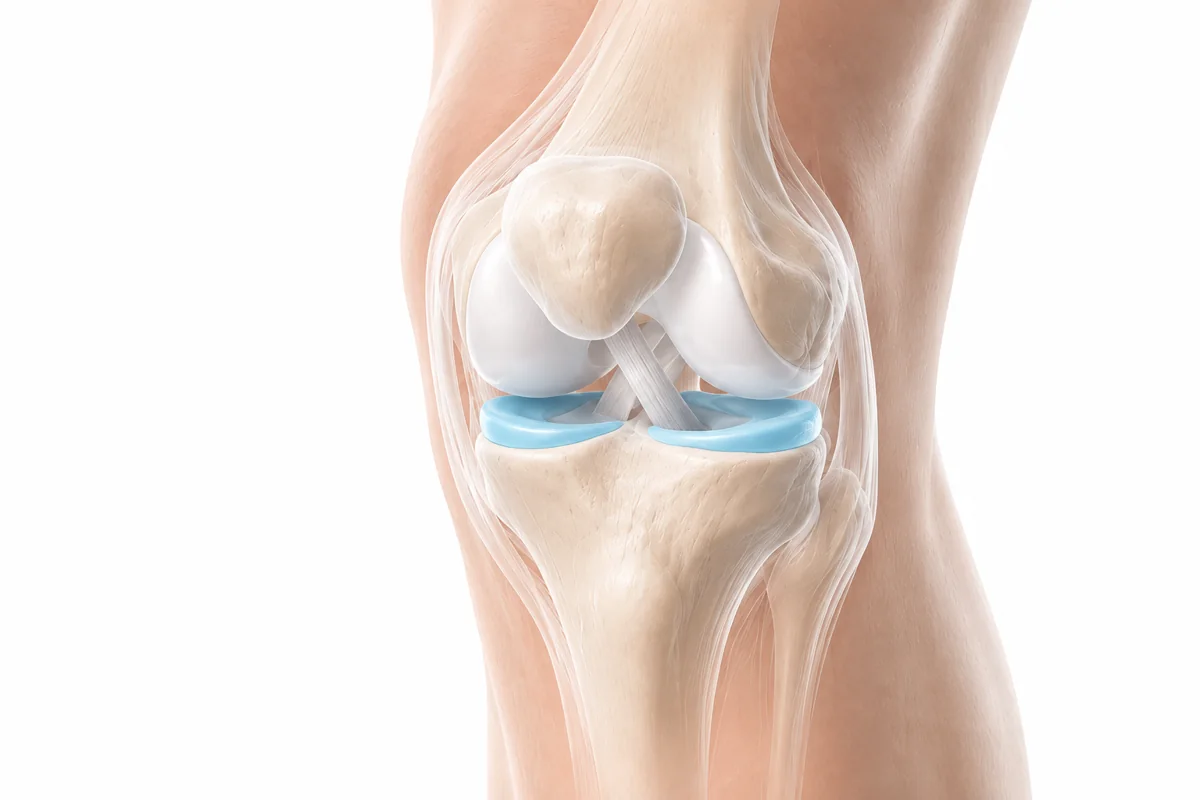
Drag to rotate through 360 degrees. With the model focused, use the arrow keys to rotate and Home to return to the overview. The highlighted area shows relevant anatomy, not a diagnosis or an individual scan.
The medial and lateral menisci are fibrocartilage structures that help distribute load and contribute to knee stability. A tear can occur during a loaded twist or deep knee position, sometimes with an ACL injury, or appear gradually as part of age-related tissue change.
An MRI tear does not automatically mean surgery is needed. Symptoms, trauma, swelling, true mechanical restriction, knee stability, activity goals and response to rehabilitation all influence the pathway.
A player may feel pain at the joint line after pivoting or squatting, followed by swelling, reduced motion or difficulty loading the knee.
Clicking alone is common and not always concerning. A knee that is physically blocked and cannot fully bend or straighten needs prompt assessment.
A scan may show meniscal change without one clear injury. The clinical focus is whether the finding matches the pain and whether strength and activity modification improve function.
These patterns help explain what to look out for. They do not confirm a diagnosis on their own.
Pain may sit along the inner or outer side of the knee joint, sometimes after a loaded twist.
Swelling can limit bending or straightening and change with activity.
Catching can have several causes. A genuinely locked knee that will not straighten needs prompt medical assessment.
Deep squatting, kneeling or rotating on a loaded knee may reproduce symptoms.
Meniscus tests are interpreted as a group because no single manoeuvre confirms every tear.
The mechanism, ability to continue, timing of swelling and any episodes of giving way or locking help distinguish meniscal injury from ligament, patellofemoral or other knee presentations.
Assessment may include joint-line tenderness, knee flexion and extension, rotation and selected loaded tests when the knee can tolerate them.
Quadriceps force, calf and hip capacity, squat, step, hop or running tasks can show the current functional limit.
MRI or specialist review may be considered after significant trauma, with a locked knee, when repairable acute tears are suspected or when progress does not match expectations.
Many meniscal presentations can begin with rehabilitation. Acute tears with mechanical restriction or selected repairable patterns may need earlier orthopaedic review.
Early work may focus on comfortable weight bearing, full extension, progressive flexion and quadriceps activation. Bracing or weight-bearing limits are followed when prescribed.
Squat, step, knee-extension, hip and calf work can be progressed through increasing range and load according to symptoms and joint response.
Running, hopping, pivoting and deep knee positions are separate demands. They are added when swelling, motion and strength support the next stage.
After meniscus repair, range, loading and running timelines may differ from a partial meniscectomy. Rehabilitation must follow the surgeon’s procedure-specific instructions.
Book after a twisting knee injury, when swelling or joint-line pain persists, or when catching limits normal movement. Seek prompt assessment if the knee is locked, significantly unstable or cannot bear weight after trauma.
Book online or call
08 6183 1790
Practical answers about symptoms, assessment and recovery.
No. Many people improve with rehabilitation, particularly when the knee is not mechanically locked. Tear pattern, trauma, age, symptoms and goals determine whether surgical review is appropriate.
Walking may be acceptable if the knee is stable and symptoms remain manageable, but a large limp, increasing swelling or inability to bear weight needs assessment. Post-operative restrictions must be followed exactly.
A true locked knee has a physical block that prevents normal bending or straightening, rather than movement stopping only because it hurts. This warrants prompt clinical assessment.
Running readiness depends on swelling, movement, strength, impact tolerance and whether surgery was performed. Book an assessment for criteria matched to the specific injury and activity.
Book online or call our Cottesloe team.
General educational information; your assessment determines the appropriate care. Supporting reference: AAOS meniscus information.
3D bone and tissue source: BodyParts3D, © The Database Center for Life Science, CC BY-SA 2.1 Japan. Meshes cropped and simplified, with illustrative highlights and some simplified soft tissues. Supporting artwork is illustrative and does not represent a scan or confirm a diagnosis. Attribution and licence.