

Distance-dependent pain
The first kilometres may feel normal before a sharper outer-knee pain appears. Downhill running or longer sessions can be more provocative because of repeated knee loading.
Assessment and rehabilitation for lateral knee pain during running, cycling or repeated knee movement, with a focus on load and task-specific capacity.

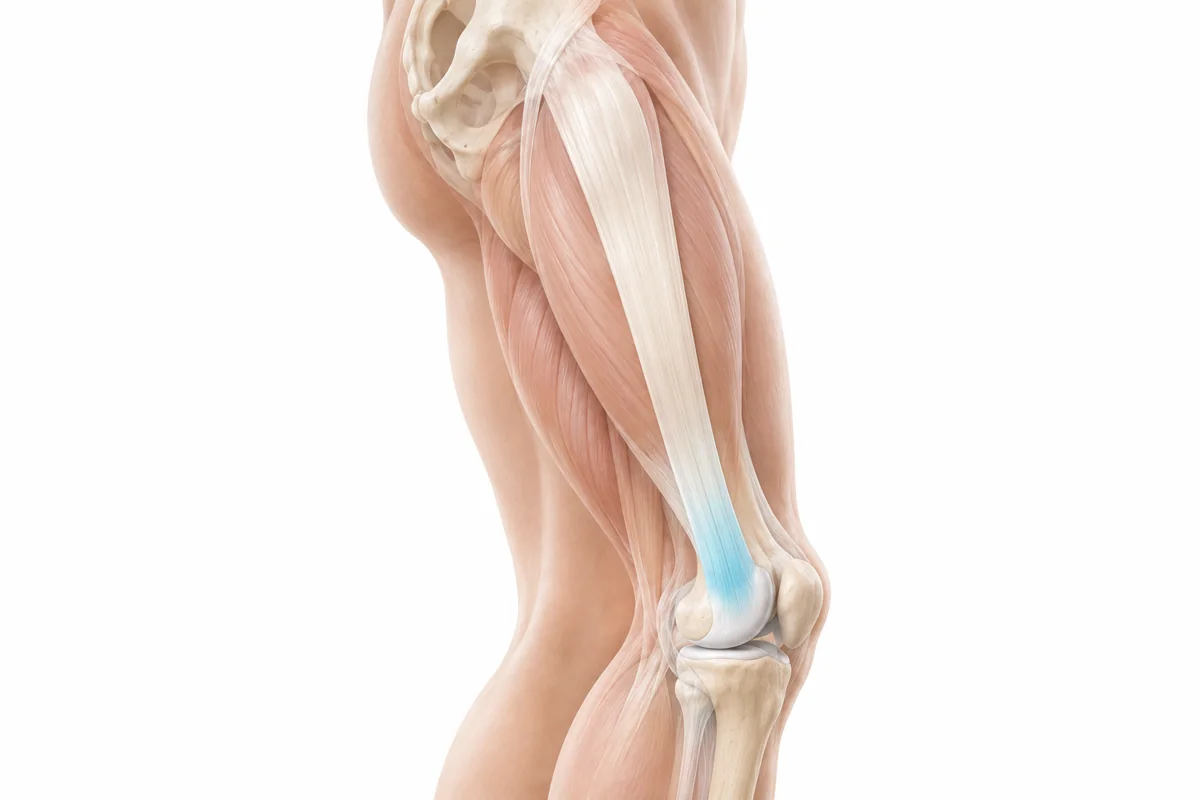
Drag to rotate through 360 degrees. With the model focused, use the arrow keys to rotate and Home to return to the overview. The highlighted area shows relevant anatomy, not a diagnosis or an individual scan.
Iliotibial band syndrome commonly causes pain on the outer side of the knee during repeated bending and straightening, particularly in runners and cyclists. Symptoms can begin after a predictable distance and ease when the activity stops.
The IT band is a strong connective tissue structure and is not simply stretched longer through a few exercises. Useful management focuses on the irritated lateral-knee tissues, recent training demands and the strength and control needed for the person’s running or cycling.
The first kilometres may feel normal before a sharper outer-knee pain appears. Downhill running or longer sessions can be more provocative because of repeated knee loading.
Pain is usually localised near the outer femoral condyle rather than around the kneecap or directly on the fibular head.
A change in distance, hills, pace, frequency, cambered surfaces or cycling volume may precede symptoms, especially after reduced training or altered recovery.
These patterns help explain what to look out for. They do not confirm a diagnosis on their own.
The discomfort is typically at the lateral knee, rather than simply a tight feeling along the whole thigh.
Running or cycling may be manageable initially, with symptoms building after repeated knee movement.
Hills, duration and recent changes in training may affect symptoms.
Symptoms may settle when the provoking activity stops, then recur if the same load is repeated.
Assessment aims to reproduce the familiar symptom and distinguish it from meniscus, ligament, patellofemoral, tendon or referred pain.
The exact location, swelling, joint-line findings and response to knee movement help establish whether an IT band pattern fits.
Squats, step-downs, hops and hip or knee strength tests may show the capacities that need development for repeated running.
When symptoms are activity-specific, treadmill running or cycling set-up can be assessed to identify the distance, pace, slope or position that triggers pain.
Weekly distance, long-run proportion, hills, surfaces, speed and other lower-limb training are mapped against the onset and recovery pattern.
Treatment reduces repeated irritation while building the lower limb for the exact activity that triggers symptoms.
Distance, hills, speed and frequency can be modified separately. A runner may retain short flat sessions while temporarily removing the point at which lateral pain escalates.
Single-leg, hip abductor, quadriceps and calf work can be progressed when testing identifies a relevant capacity limit.
A small cadence, stride or bike-position change may reduce symptoms for some people. It should be tested for an immediate useful effect rather than applied as a universal correction.
Longer duration, descents, faster work and fatigue are restored as separate steps so the lateral knee adapts without a large jump in demand.
Book when outer-knee pain repeatedly stops a run or ride, appears earlier over time, or persists into daily activity. Trauma, marked swelling, locking or inability to bear weight requires assessment for another knee injury.
Book online or call
08 6183 1790
Practical answers about symptoms, assessment and recovery.
The IT band itself is strong connective tissue and does not lengthen meaningfully like a muscle. Mobility work may change symptoms around the hip, but load adjustment and strength are usually more central.
Often a reduced dose below the symptom threshold can be retained. Distance, hills, pace and frequency may need individual changes while capacity is rebuilt.
Hip capacity can be relevant, but it is not the only cause. Training load, knee capacity, running demands and symptom behaviour should be assessed together.
Repeated load can reach the irritated tissue’s current threshold after a predictable time. Book an assessment to confirm the pain source and plan how that threshold can be progressed.
Book online or call our Cottesloe team.
General educational information; your assessment determines the appropriate care. Supporting reference: AAOS hamstring information.
3D bone and tissue source: BodyParts3D, © The Database Center for Life Science, CC BY-SA 2.1 Japan. Meshes cropped and simplified, with illustrative highlights and some simplified soft tissues. Supporting artwork is illustrative and does not represent a scan or confirm a diagnosis. Attribution and licence.