

Tennis elbow pattern
Pain is commonly provoked by gripping, lifting with the palm down, backhand strokes or resisted wrist extension. Tenderness is usually localised near the outer bony prominence.
Assessment and progressive loading for pain on the outer or inner elbow that affects gripping, lifting, racquet sport, golf or manual work.

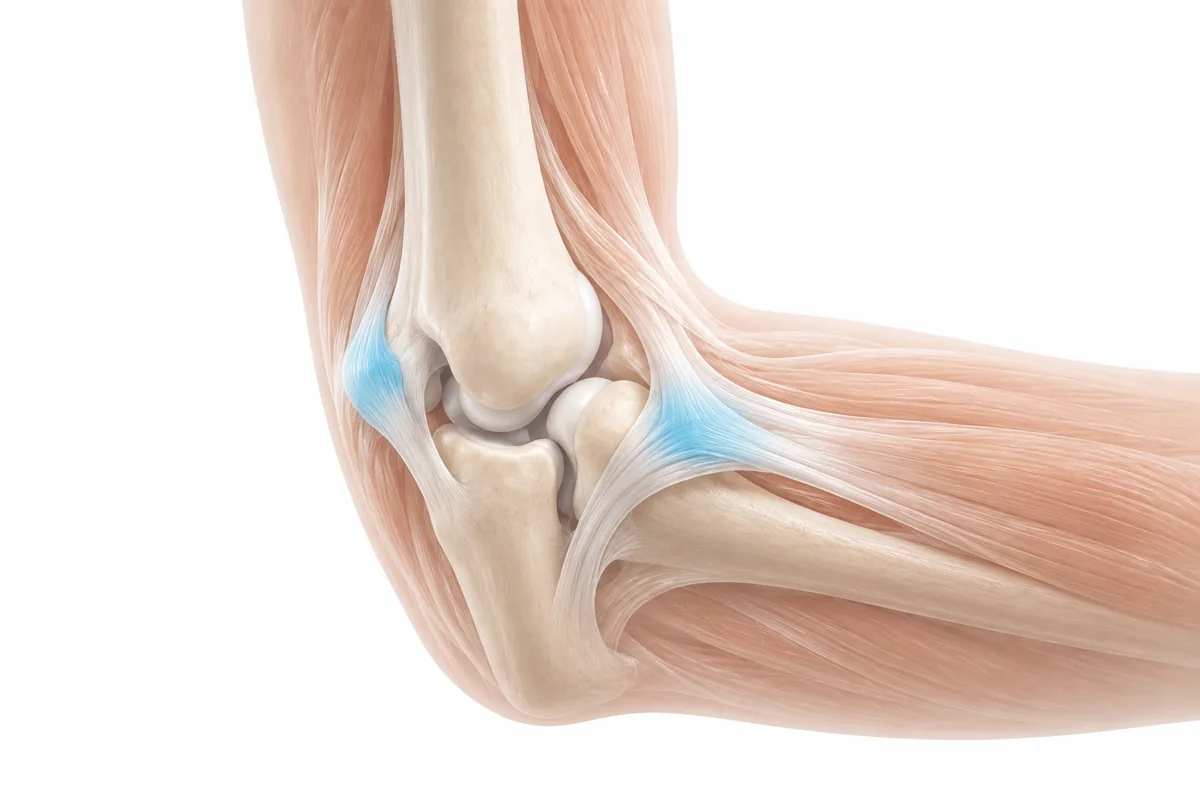
Drag to rotate through 360 degrees. With the model focused, use the arrow keys to rotate and Home to return to the overview. The highlighted area shows relevant anatomy, not a diagnosis or an individual scan.
Tennis elbow usually refers to lateral elbow tendinopathy involving the wrist extensor tendon attachment on the outside of the elbow. Golfer’s elbow usually refers to medial elbow tendinopathy involving the wrist flexor and pronator attachment on the inside.
Neither condition requires playing the sport in its name. Repeated gripping, tool use, lifting, keyboard or mouse work, climbing, gym training and sudden increases in racquet or golf volume can all contribute. Nerve, joint or referred neck pain can produce a similar location and must be considered.
Pain is commonly provoked by gripping, lifting with the palm down, backhand strokes or resisted wrist extension. Tenderness is usually localised near the outer bony prominence.
Pain on the inner elbow can increase with gripping, wrist flexion, pronation, throwing or the impact phase of a golf swing.
Symptoms often reflect how much force, repetition and recovery the forearm has recently managed. A light task repeated for hours can matter as much as one heavy effort.
These patterns help explain what to look out for. They do not confirm a diagnosis on their own.
Tennis elbow usually affects the wrist extensor attachment on the outside of the elbow.
Golfer’s elbow usually affects the flexor and pronator attachment on the inside.
Lifting, tools, racquet sports or holding a heavy object can reproduce symptoms.
Repeated wrist or forearm work may become difficult. Numbness or radiating symptoms also need nerve assessment.
The examination tests which tissues and loads reproduce symptoms and whether the neck, nerve or elbow joint contributes.
The exact tender area, morning response, warm-up effect and reaction after work or sport help establish a tendon pattern and suitable starting load.
Grip force and resisted wrist extension, flexion or rotation can be compared with the other side and tested at relevant elbow angles.
Pins and needles, broad forearm pain, neck symptoms or pain not reproduced by local loading may require neurological and cervical assessment.
Tool handle size, racquet set-up, stroke volume, lifting grip or workstation exposure may be reviewed when they clearly change the tendon demand.
Rest can reduce symptoms temporarily but often does not restore the forearm’s ability to tolerate work or sport. Rehabilitation combines a manageable activity dose with progressive loading.
The starting plan may change repetition, grip force, lifting position or weekly sport volume while retaining tasks that remain tolerable.
Isometric or dynamic wrist exercises can progress in resistance, range and speed. Supination, pronation, elbow and shoulder strength may be added when relevant.
Later loading should resemble the actual demand, such as sustained tool use, repeated racquet strokes, carrying, climbing or high-force gym grip.
Manual therapy, taping or a brace may offer short-term symptom change for some people, but they should support rather than replace capacity-building exercise.
Book when elbow pain is limiting grip, lifting, work, gym or sport, or when symptoms return every time load increases. Sudden trauma, marked swelling, locking or progressive hand weakness needs prompt assessment.
Book online or call
08 6183 1790
Practical answers about symptoms, assessment and recovery.
Tennis elbow usually affects the outer wrist-extensor tendon attachment. Golfer’s elbow usually affects the inner flexor-pronator attachment. The provoking tests and loading programme therefore differ.
Complete rest may settle pain but can leave the tendon unprepared for the same demand. A more useful plan usually modifies aggravating load while progressively rebuilding grip and forearm capacity.
A brace can reduce symptoms during some tasks, but it does not replace progressive loading. Book an assessment if you need help deciding whether support has a useful role.
The load may still exceed capacity, the exercise dose may be unsuitable, or another source such as a nerve, joint or neck problem may be contributing. Reassessment can clarify the reason.
Book online or call our Cottesloe team.
General educational information; your assessment determines the appropriate care. Supporting reference: NHS tennis elbow information.
3D bone and tissue source: BodyParts3D, © The Database Center for Life Science, CC BY-SA 2.1 Japan. Meshes cropped and simplified, with illustrative highlights and some simplified soft tissues. Supporting artwork is illustrative and does not represent a scan or confirm a diagnosis. Attribution and licence.