

Pain at the back or sides of the heel
The heel can be tender when squeezed and sore with running, jumping or pushing off. Some children begin walking on their toes or limping after sport.
Assessment and load guidance for growing athletes with heel pain linked to running, jumping and irritation of the heel growth plate.

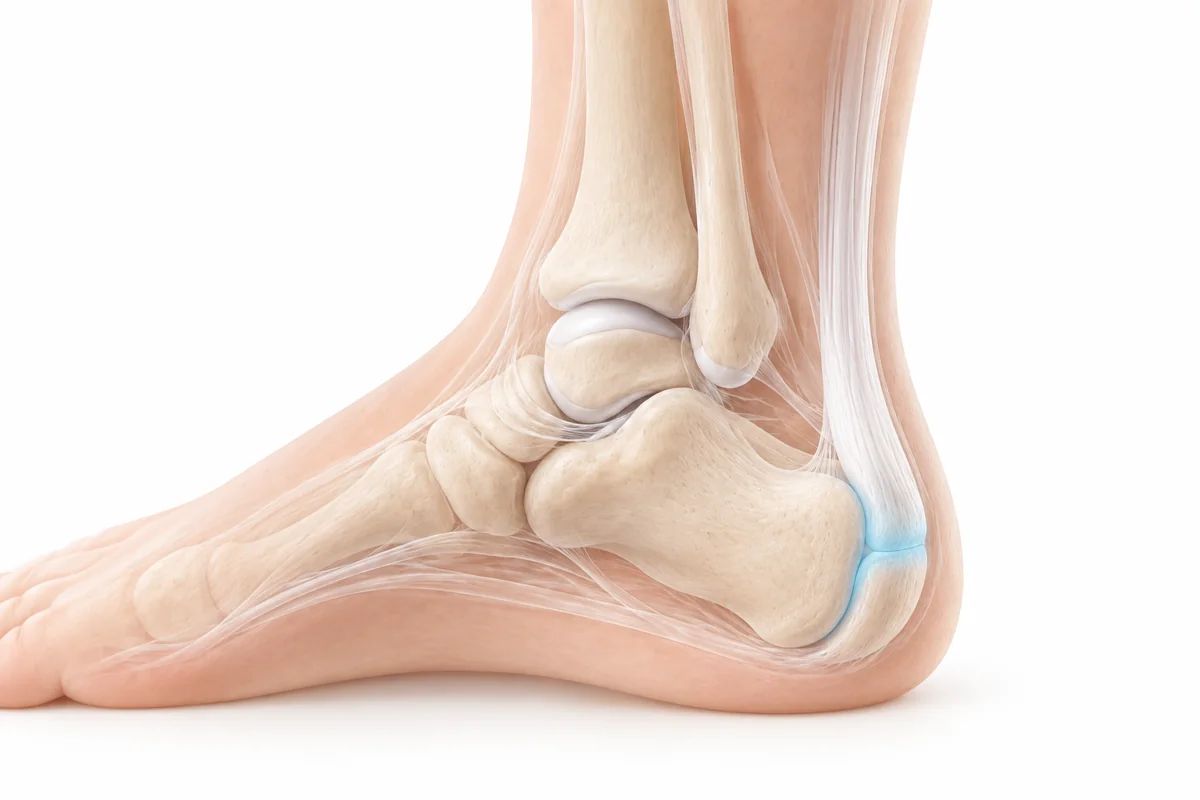
Drag to rotate through 360 degrees. With the model focused, use the arrow keys to rotate and Home to return to the overview. The highlighted area shows relevant anatomy, not a diagnosis or an individual scan.
Sever’s disease, or calcaneal apophysitis, is irritation at the growth plate at the back of the heel. It occurs in growing children and is commonly aggravated by running, jumping and field or court sport.
The Achilles tendon and impact forces both load this area. Symptoms often rise when sport volume increases or during a growth phase, and may affect one or both heels.
The heel can be tender when squeezed and sore with running, jumping or pushing off. Some children begin walking on their toes or limping after sport.
Several training sessions, school sport and weekend matches can create a much higher total load than any single coach sees.
Hard surfaces, low-cushion shoes or changing between boots and school shoes may alter symptoms, although footwear is rarely the only factor.
These patterns help explain what to look out for. They do not confirm a diagnosis on their own.
The growth area where the Achilles attaches can become sore in a growing child.
Running, jumping and field or court sport commonly aggravate symptoms.
A change in walking or avoiding heel contact is a reason to reduce provoking activity and arrange assessment.
Symptoms may coincide with growth and increased sporting load, but atypical pain still needs examination.
Assessment checks whether the history and local findings fit Sever’s disease and whether another cause of heel pain needs investigation.
Age, recent growth, sport schedule and the timing of pain before, during and after activity are reviewed with the child and parent.
The tender area, heel squeeze response, Achilles insertion and ankle movement help distinguish the likely pain source.
These tasks show whether normal gait, calf function and impact tolerance are changing. They are not forced when pain is high.
Pain at rest or night, marked swelling, fever, systemic illness, significant trauma or inability to bear weight requires medical assessment rather than assuming a growth-related condition.
The practical goal is to keep the child active at a tolerable level while reducing repeated heel flare-ups through the growth phase.
Running, jumping, PE, training and matches are considered together. A temporary reduction in the most painful sessions may be enough without stopping all sport.
Pain that causes limping, alters normal movement or remains substantially worse the next day indicates the activity dose needs review.
Calf, foot, knee and hip exercise can be introduced in tolerable ranges and progressed as heel irritability falls.
Cushioned footwear or a temporary heel lift may reduce symptoms for some children. The effect should be tested, and the device should not replace load management.
Book when a child is limping, repeatedly stopping activity, waking with heel pain or not improving after sensible load changes. Severe pain after trauma, fever, unexplained swelling or inability to bear weight needs prompt medical assessment.
Book online or call
08 6183 1790
Practical answers about symptoms, assessment and recovery.
Often yes, if the activity dose does not cause limping, escalating pain or prolonged loss of function. An assessment can help coordinate school, club and match load.
It is associated with an open heel growth plate and usually settles as growth progresses, but symptoms can recur during the active growth period if load repeatedly exceeds tolerance.
Heel cups, lifts or cushioned footwear may reduce pain for some children. They are an optional symptom tool alongside activity planning and exercise.
Typical Sever’s disease is usually diagnosed clinically. Imaging may be needed after trauma or when symptoms are severe, atypical or not following the expected pattern.
Book online or call our Cottesloe team.
General educational information; your assessment determines the appropriate care. Supporting reference: AAOS Sever’s disease information.
3D bone and tissue source: BodyParts3D, © The Database Center for Life Science, CC BY-SA 2.1 Japan. Meshes cropped and simplified, with illustrative highlights and some simplified soft tissues. Supporting artwork is illustrative and does not represent a scan or confirm a diagnosis. Attribution and licence.