

Location is only the start
Adductor, hip-flexor, pubic, inguinal and hip-joint presentations can overlap. Precise palpation and pain reproduction during resisted or movement tests help classify the problem.
Assessment and rehabilitation for hip and groin pain affecting walking, running, kicking, change of direction, gym or daily movement.

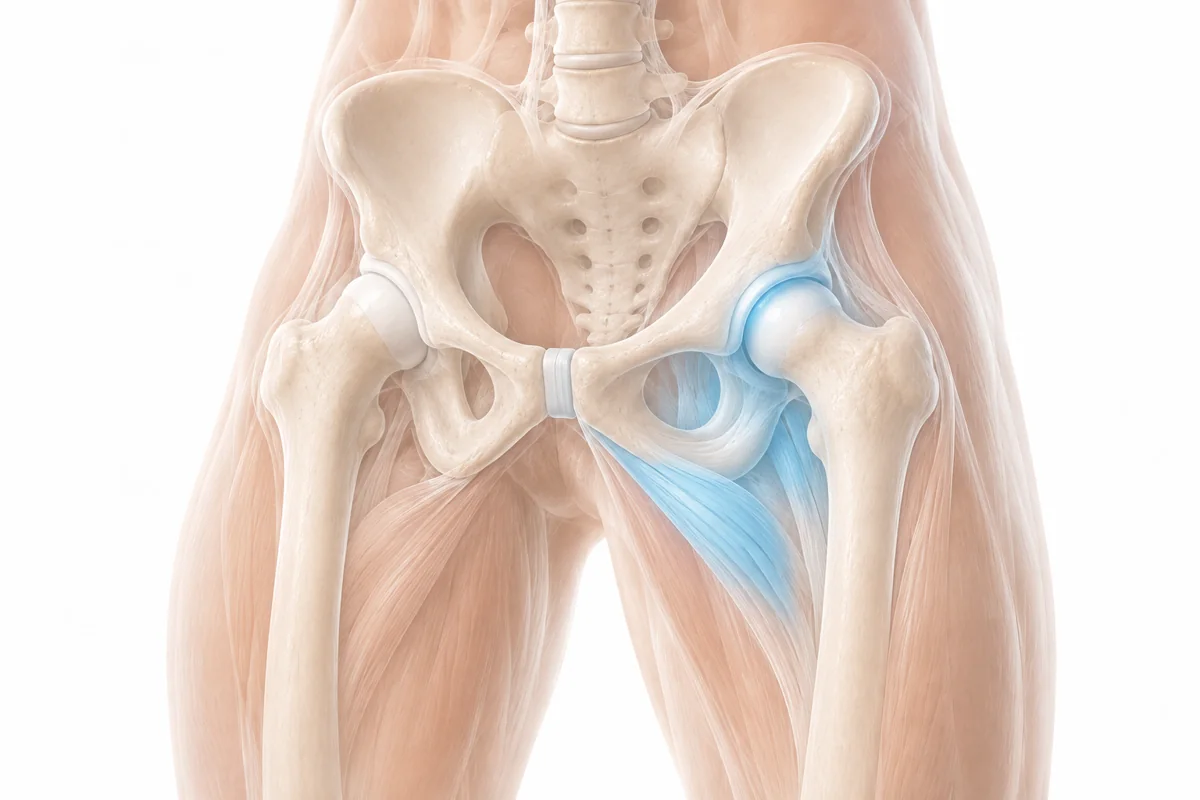
Drag to rotate through 360 degrees. With the model focused, use the arrow keys to rotate and Home to return to the overview. The highlighted area shows relevant anatomy, not a diagnosis or an individual scan.
Pain at the hip or groin can arise from several closely located structures and may involve more than one clinical entity. In athletes, recognised categories include adductor-related, iliopsoas-related, inguinal-related, pubic-related and hip-related groin pain. Other causes also need consideration.
The symptom may begin suddenly during sprinting, kicking or a change of direction, or build gradually as running and training load increases. Hip stiffness during squatting or sitting is a different presentation from pain during resisted adduction or high-speed kicking.
Adductor, hip-flexor, pubic, inguinal and hip-joint presentations can overlap. Precise palpation and pain reproduction during resisted or movement tests help classify the problem.
Field sport may provoke groin pain during acceleration, cutting and kicking, while gym or daily presentations may be more apparent in deep hip flexion, stairs or prolonged sitting.
These patterns help explain what to look out for. They do not confirm a diagnosis on their own.
Sprinting, changing direction and kicking load several structures around the groin.
Resisted adduction can reproduce some groin presentations, but is not enough to establish a diagnosis.
Squatting, sitting or rotating the hip may feel restricted or painful.
Front-of-hip, inner-thigh and pubic pain can overlap. Accurate location and examination help separate the causes.
A thorough history and examination are central because imaging findings do not always identify which structure is producing symptoms.
Assessment maps the pain, onset and response to running, kicking, cutting, squeezing, sitting, squatting or changing direction.
Targeted palpation, adductor and hip-flexor resistance, stretch and abdominal or inguinal tests may help identify a recognised clinical pattern.
Hip range and provocation tests are considered alongside the back, pelvis and other sources when the presentation does not fit one local structure.
Adductor, hip and trunk strength can be assessed with running, kicking or change-of-direction tasks added when appropriate.
Management is based on the clinical entity, irritability and activity demands. A generic hip stretch or core program is unlikely to address every groin presentation.
The plan can identify which speeds, distances, kicks or gym movements remain tolerable and which need temporary modification.
Exercise may progress adductor, hip-flexor, gluteal and trunk capacity according to the specific deficits and symptom response.
Sprinting, cutting, kicking and wide reaching positions can be reintroduced in stages rather than left until normal training resumes.
Hip-joint symptoms, significant trauma, persistent night pain or failure to progress may require medical review, imaging or specialist input.
A physiotherapy assessment can classify the presentation, test the relevant strength and movement, and determine whether rehabilitation or further medical investigation is the appropriate next step.
Book online or call
08 6183 1790
Practical answers about symptoms, assessment and recovery.
Groin pain may be adductor-related, iliopsoas-related, inguinal-related, pubic-related or hip-related, and more than one category can be present. Other medical and referred causes also need consideration.
No. Osteitis pubis is one label associated with the pubic region. Groin pain can involve several other clinical entities, so location alone should not determine the diagnosis.
It may include precise symptom mapping, palpation, resisted adductor or hip-flexor tests, hip movement, strength and relevant running, kicking or change-of-direction tasks.
Some running may remain appropriate, but speed, distance, cutting and kicking can affect symptoms differently. An assessment can set a tolerable starting load and progression.
Book online or call our Cottesloe team.
General educational information; your assessment determines the appropriate care. Supporting reference: Doha agreement on groin pain.
3D bone and tissue source: BodyParts3D, © The Database Center for Life Science, CC BY-SA 2.1 Japan. Meshes cropped and simplified, with illustrative highlights and some simplified soft tissues. Supporting artwork is illustrative and does not represent a scan or confirm a diagnosis. Attribution and licence.