

Traumatic pain
A rolled ankle, awkward landing or direct blow may produce swelling, bruising, loss of movement or difficulty bearing weight. Fracture and higher ankle injuries need consideration.
Assessment and rehabilitation for ankle and foot pain affecting walking, running, jumping, change of direction or daily activity.

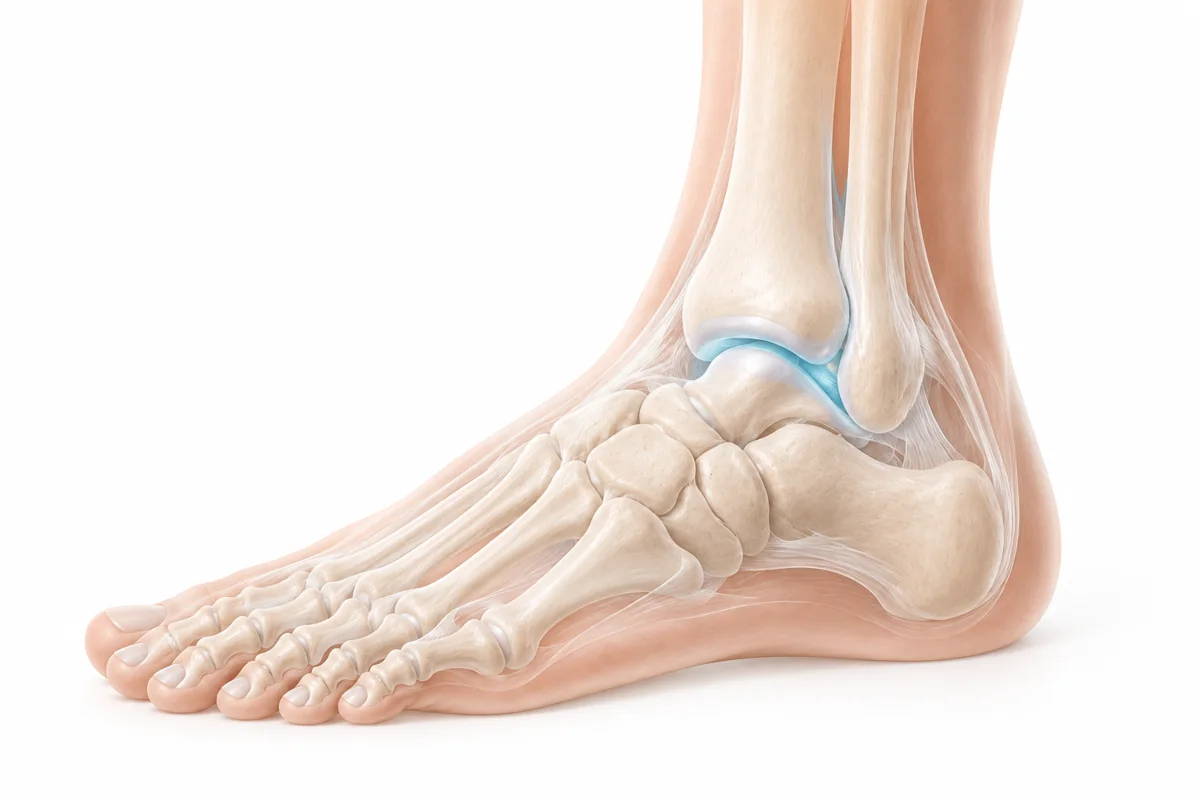
Drag to rotate through 360 degrees. With the model focused, use the arrow keys to rotate and Home to return to the overview. The highlighted area shows relevant anatomy, not a diagnosis or an individual scan.
Pain around the ankle, heel or foot may follow a sprain, direct impact or fracture, or develop gradually in a tendon, the plantar fascia, a joint or bone. The location and timing help, but they do not establish the diagnosis without examination.
Walking and running expose the foot and ankle to repeated load, while field and court sport add landing, cutting and contact. Footwear, surface, recent training and previous sprains may all be relevant to the current presentation.
A rolled ankle, awkward landing or direct blow may produce swelling, bruising, loss of movement or difficulty bearing weight. Fracture and higher ankle injuries need consideration.
Achilles, plantar heel, tendon and bone-stress presentations often change with running volume, speed, hills, jumping, footwear or time on the feet.
These patterns help explain what to look out for. They do not confirm a diagnosis on their own.
Walking, running or standing may become uncomfortable at the ankle, heel or foot.
Swelling and bruising after a roll or impact can involve ligaments, bone, cartilage or tendons.
The exact location and whether pain occurs on first steps or during loading help guide assessment.
Weakness, stiffness or repeated rolling can affect confidence on uneven ground and in sport.
The examination differentiates joint, ligament, tendon, fascia, bone and referred presentations, then connects the findings with walking, running or sport.
Assessment reviews trauma, swelling, bruising, pain location, morning stiffness, walking tolerance and recent changes in running, jumping or work load.
Range, palpation, ligament or syndesmosis tests, tendon loading and other condition-specific tests are selected from the presentation.
Single-leg heel raises, balance, hopping and lower-limb strength can be assessed at an appropriate level.
Gait, running tasks, shoes and sport surface are considered when they reproduce the symptoms or change the load on the injured area.
The plan depends on the diagnosis. An acute ligament injury, Achilles tendinopathy and plantar heel pain have different loading and progression needs.
After a recent injury, the first goals may include safe weight bearing, swelling management, joint motion and decisions about support, imaging or referral.
Strength can progress from supported work to single-leg heel raises, heavier loading, hopping and faster actions when relevant.
Walking volume, running, hills, jumping and change of direction can be restored separately so the response to each demand is clear.
Shoes, taping, braces or orthoses may be considered for a defined reason, but they do not replace the strength and activity progression required by many presentations.
Book when pain or swelling affects walking, running or sport, when a rolled ankle remains unstable, or when gradual heel or tendon pain is not settling as load changes.
Book online or call
08 6183 1790
Practical answers about symptoms, assessment and recovery.
Book when swelling, pain, loss of movement or difficulty walking and hopping persists, or when the ankle feels unstable. Marked deformity, severe trauma or inability to bear weight needs prompt medical assessment.
Possible causes include Achilles tendon problems, irritation around the heel, or growth-related calcaneal apophysitis in children. The location, age, load history and examination help distinguish them.
Yes. Assessment can examine the painful structure, calf and foot capacity, running load, footwear and the exact distance, speed or surface that provokes symptoms.
Support may be useful for some presentations, but it should have a clear purpose. The decision depends on the diagnosis, current symptoms, activity and whether external support changes function.
Book online or call our Cottesloe team.
General educational information; your assessment determines the appropriate care. Supporting reference: AAOS foot and ankle information.
3D bone and tissue source: BodyParts3D, © The Database Center for Life Science, CC BY-SA 2.1 Japan. Meshes cropped and simplified, with illustrative highlights and some simplified soft tissues. Supporting artwork is illustrative and does not represent a scan or confirm a diagnosis. Attribution and licence.