

Painful stage
Pain may be strong at night and at the end of movement, while stiffness is becoming more apparent. Aggressive stretching during a highly irritable stage can aggravate symptoms.
Assessment and stage-appropriate management for a painful, progressively stiff shoulder consistent with adhesive capsulitis.

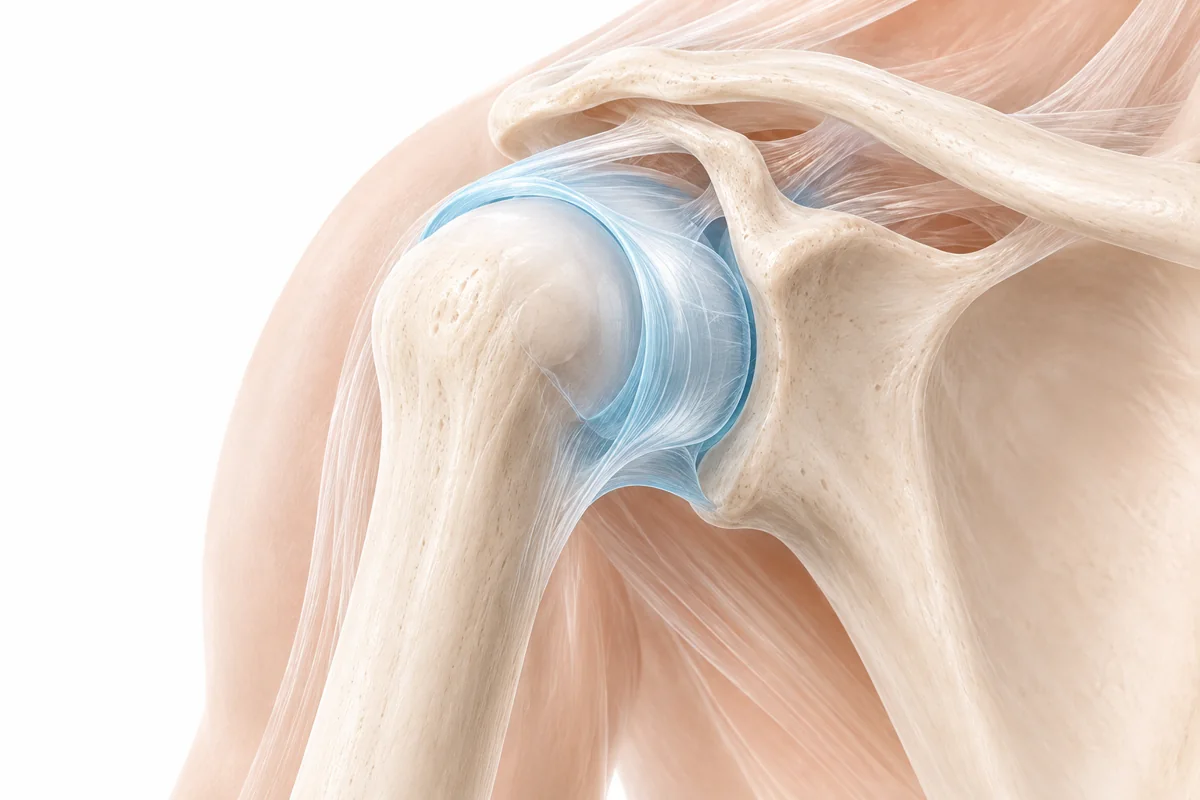
Drag to rotate through 360 degrees. With the model focused, use the arrow keys to rotate and Home to return to the overview. The highlighted area shows relevant anatomy, not a diagnosis or an individual scan.
Frozen shoulder, or adhesive capsulitis, is characterised by a gradual loss of both active and passive shoulder movement. Reaching overhead, behind the back or out to the side can become restricted, often with substantial night pain in the more irritable stage.
It commonly develops without one clear injury, although it can follow surgery, trauma or a period of immobilisation. Diabetes and some thyroid conditions are associated with a higher risk. The course can be prolonged and varies considerably between people.
Pain may be strong at night and at the end of movement, while stiffness is becoming more apparent. Aggressive stretching during a highly irritable stage can aggravate symptoms.
Pain may reduce while the loss of motion remains obvious. External rotation is often particularly restricted, with dressing, grooming and reaching behind the back affected.
Movement can gradually improve, but strength and confidence may still need rebuilding for work, gym and sport after months of restricted use.
These patterns help explain what to look out for. They do not confirm a diagnosis on their own.
The shoulder becomes harder to move, including when someone else gently helps move the arm.
Turning the arm outward or reaching behind the back can become particularly difficult.
Pain can disturb sleep, especially during a more irritable phase.
Dressing, washing hair and reaching a shelf may need temporary adjustments while movement is gradually rebuilt.
Frozen shoulder is a clinical diagnosis. Assessment compares active and passive movement, symptom behaviour and the wider medical and shoulder history.
The joint remains restricted when the person moves the arm and when the examiner moves it. This differs from weakness or pain that limits active movement while passive range is relatively preserved.
External rotation is commonly restricted, with abduction and internal rotation also affected. The exact limitation and irritability guide how forcefully movement should be tested or treated.
The assessment reviews onset, previous surgery or immobilisation, diabetes or thyroid history and any features that suggest another shoulder or neurological condition.
A scan does not usually confirm frozen shoulder, but imaging or medical review may be used when trauma or another diagnosis needs to be excluded.
The goal is to preserve useful movement, manage pain and progressively restore function without repeatedly provoking a highly irritable joint.
Short, regular movements within an acceptable response may be more useful than forceful stretching. Range and intensity can increase as irritability reduces.
Rotator cuff, shoulder-blade and arm exercises can be adapted to the available range so the entire upper limb is not deconditioned while motion is limited.
Sleep position, dressing, reaching and work tasks can be modified while the shoulder is stiff. These strategies should support activity rather than imply that movement is unsafe.
When pain is severe or progress is limited, a GP or specialist may discuss medication, injection or other options. Physiotherapy then needs to align with that plan and the current stage.
Book when shoulder movement is progressively shrinking, night pain is persistent, or daily tasks such as dressing and reaching behind the back are becoming difficult. A sudden loss after trauma should be assessed promptly for other injuries.
Book online or call
08 6183 1790
Practical answers about symptoms, assessment and recovery.
It can last many months and sometimes longer, but the course varies. Stage, irritability, health factors and function are more useful for planning than assuming one fixed recovery date.
Not when it repeatedly causes a large or prolonged flare-up. Mobility work should be matched to irritability, particularly during the painful stage. Book an assessment to establish a suitable dose.
It can affect the other shoulder at a different time, although both shoulders are not necessarily affected. New stiffness still needs assessment because other conditions can present similarly.
Often the diagnosis is made clinically. Imaging may be used when the history or examination suggests another condition, particularly after trauma or when the pattern is atypical.
Book online or call our Cottesloe team.
General educational information; your assessment determines the appropriate care. Supporting reference: NHS frozen shoulder information.
3D bone and tissue source: BodyParts3D, © The Database Center for Life Science, CC BY-SA 2.1 Japan. Meshes cropped and simplified, with illustrative highlights and some simplified soft tissues. Supporting artwork is illustrative and does not represent a scan or confirm a diagnosis. Attribution and licence.