

Lateral ankle sprain
Pain and swelling commonly sit around the outer ankle after an inversion injury. The anterior talofibular ligament is frequently involved, sometimes with the calcaneofibular ligament.
Assessment and rehabilitation after a rolled ankle, with progression from swelling and walking to hopping, direction change and sport.

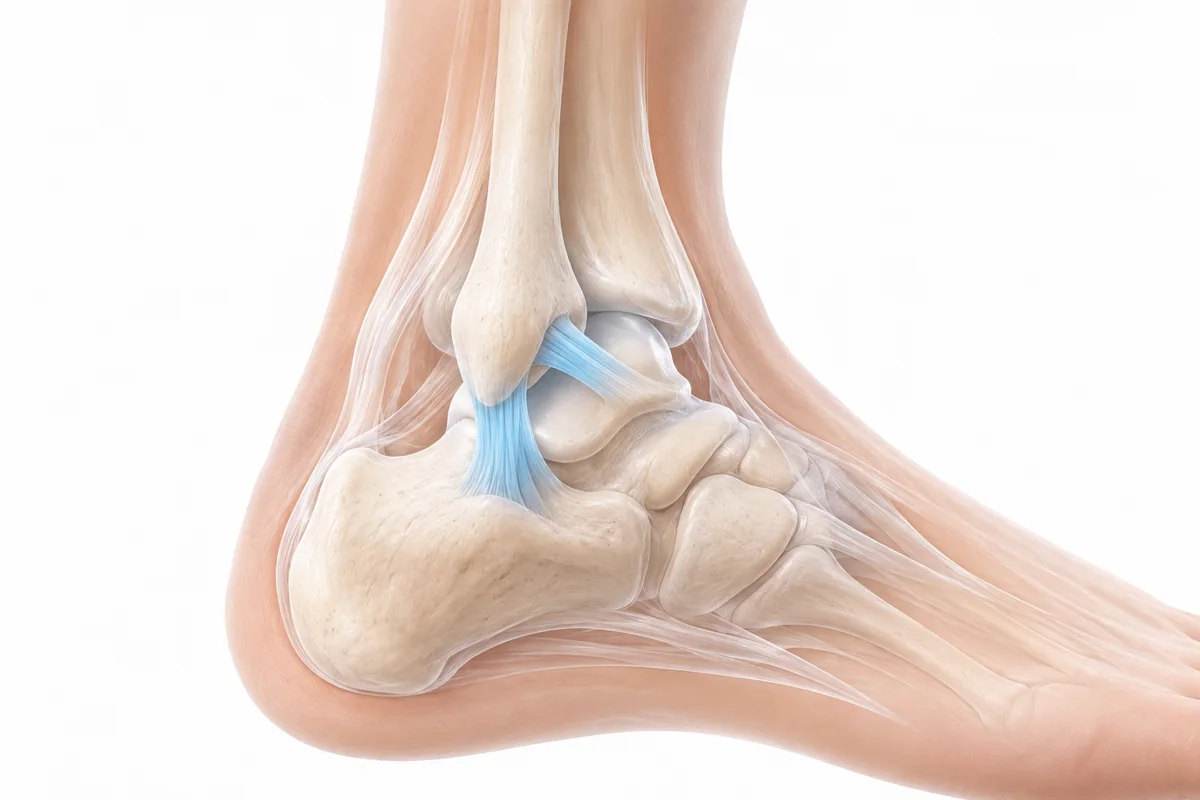
Drag to rotate through 360 degrees. With the model focused, use the arrow keys to rotate and Home to return to the overview. The highlighted area shows relevant anatomy, not a diagnosis or an individual scan.
Most ankle sprains occur when the foot rolls inward and loads the ligaments on the outside of the ankle. The injury can range from a mild sprain to substantial ligament damage, and bone, cartilage, tendon or the higher ankle ligaments may also be involved.
The amount of swelling is not a reliable return-to-sport test. An athlete can walk comfortably while still lacking ankle motion, calf capacity, balance, confidence or the ability to absorb and redirect force at speed.
Pain and swelling commonly sit around the outer ankle after an inversion injury. The anterior talofibular ligament is frequently involved, sometimes with the calcaneofibular ligament.
Pain above the ankle joint after the foot is forced outward or rotated may involve the syndesmosis. These injuries often require different protection and a longer progression.
Repeated sprains can leave a sense of giving way, reduced balance and difficulty with uneven ground or change of direction even after swelling has settled.
These patterns help explain what to look out for. They do not confirm a diagnosis on their own.
An inward roll commonly loads the outer ligaments, but other structures can also be injured.
The ankle may swell and become bruised. Swelling alone does not show readiness to return to sport.
Painful weight bearing or marked bone tenderness needs early assessment to consider fracture risk.
The ankle may feel unreliable during balance, landing or direction changes after the initial pain improves.
Early assessment identifies whether routine rehabilitation is appropriate and establishes the impairments that need to change before sport.
The direction of the roll, ability to take four steps and location of bone tenderness help determine whether fracture imaging criteria may be met.
Palpation and selected stress tests assess the likely ligament pattern. The peroneal tendons, Achilles, syndesmosis and midfoot are checked when the mechanism or pain location indicates.
Dorsiflexion, calf strength, single-leg balance and control are compared with the other side and with the demands of the person’s activity.
Later assessment can include jumping, landing, repeated hopping, acceleration and change of direction. Confidence and perceived stability are considered alongside physical measures.
The plan is staged according to injury severity. Early protection may be needed, but rehabilitation should then restore the capacities that reduce recurrent giving way.
Compression, support and relative protection may help early. Weight bearing and ankle movement are progressed according to pain, swelling, stability and any medical restrictions.
Calf raises, inversion and eversion work and loaded ankle control can progress from supported to single-leg, heavier and faster tasks.
Balance work progresses from stable single-leg positions to reaching, landing and responding to unplanned movement. Wobble work alone is not enough for high-speed sport.
Taping or a brace may be useful during return to court or field sport, especially after recurrent sprains. It complements rather than replaces strength and movement rehabilitation.
Book when walking remains difficult, swelling or bruising is marked, the ankle feels unstable, or sport requires jumping and direction change. Deformity, severe bone tenderness, inability to bear weight or altered circulation or sensation needs prompt medical assessment.
Book online or call
08 6183 1790
Practical answers about symptoms, assessment and recovery.
Early assessment is useful when walking is difficult, swelling is substantial, there is bone tenderness or the injury occurred in sport. It can screen fracture risk and set appropriate protection and loading.
Straight-line running is only one demand. Pain, ankle motion, strength, balance, hopping, change of direction, confidence and sport-specific function should also be considered.
A brace or taping can help some athletes during return to sport, particularly after recurrent sprains. The choice should match the sport, injury and rehabilitation plan.
Previous ligament injury can be followed by strength, balance, motion or confidence deficits. Book an assessment to identify which factor is limiting stability and whether further medical review is needed.
Book online or call our Cottesloe team.
General educational information; your assessment determines the appropriate care. Supporting reference: AAOS foot and ankle information.
3D bone and tissue source: BodyParts3D, © The Database Center for Life Science, CC BY-SA 2.1 Japan. Meshes cropped and simplified, with illustrative highlights and some simplified soft tissues. Supporting artwork is illustrative and does not represent a scan or confirm a diagnosis. Attribution and licence.